Jidokoku
The Silver ChairUnderland is the subterranean world beneath the surface, a realm where descent replaces the open landscapes above and where the travelers’ route leads through deep caves, a lightless sea, and a densely inhabited city. Its geography is not merely a setting: darkness, cold, and rising water repeatedly dictate what the travelers can see, where they can go, and whether they can get out alive.
A world below the surface
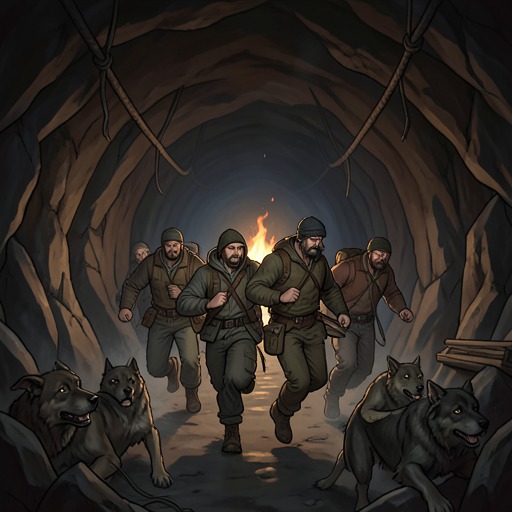
The travelers first encounter Underland as a place of military authority. A voice identifies its speaker as the Warden of the Marches of Underland, accompanied by a hundred armed Earthmen, and demands to know who they are and what business they have in the Deep Realm. Puddleglum answers that they fell down by accident. The Warden’s warning that many fall but few return to the sunlit lands establishes descent as a perilous passage rather than a simple change of location.
The route down is physically and psychologically oppressive. The travelers pass from one cave into another, each lower than the last, until the weight of earth above them seems suffocating. Their escort eventually relights a cheerless lantern in a cavern so wide and dark that only a strip of pale sand, still water, and a small jetty can be made out. A vessel with neither mast nor sail waits there, propelled by many oars. The sequence makes vertical depth the defining feature of the landscape: the further the travelers descend, the more the visible world contracts to a dim light and the next stretch of passage.
The underground sea and city
The oared ship carries the travelers across smooth water into near-total darkness. Its lantern illuminates only a short distance; ahead, the water fades into blackness. Huddled beside Puddleglum, Jill and Eustace find that the Marsh-wiggle who seemed a gloomy companion above ground has become their only comfort. Puddleglum steadies Jill by pointing out that their route has brought them beneath the Ruined City, in accordance with the instructions they were meant to follow.
The city they reach is immense but only intermittently visible. A few scattered lights reveal the character of a great seaport: ships loading and unloading, bales and warehouses, and structures resembling palaces or temples. Hundreds of Earthmen move through streets, squares, and stairways, yet the activity makes no ordinary urban clamor. There are no songs, shouts, bells, or rattling wheels, only a soft murmur and the repeated pad of feet. The city is busy and crowded, but its dimness and silence give it the character of an ant-hill rather than a lively human settlement.
The travelers are taken ashore and marched through the crowds, past sad and grotesque faces. The Earthmen appear intent on their work, although Jill cannot discover what they are doing; none seems interested in the strangers. Their passage ends in a great castle, reached by crossing a courtyard and climbing many staircases. In a murkily lit room, an arch opens onto a strikingly different sight: warm, honest yellow lamplight and the foot of a stone staircase winding upward. Two Earthmen stand beside it like sentries. The contrast makes the upward route legible as a threshold between the underground realm and the world above.
Routes, hardship, and the surface contrast
The underground journey is part of a longer movement through contrasting environments. Above ground, the travelers have crossed a marsh cut into countless small islands by channels, with reeds, rushes, scattered wigwams, and birds. Under a fresh morning sun, that lonely wetland feels clean and invigorating. The later approach to Harfang is markedly harsher: the road descends through narrow valleys exposed to a cruel north wind, with no firewood or sheltered hollows, stony ground, and nights that leave the travelers sore.
At the hill above the Ruined City, weather and terrain further restrict movement. The travelers climb four irregular ledges in deepening snow; on the flat summit, a fierce wind drives the snow into their faces and sweeps it off the ground in sheets. Banks or dykes, two to five feet high, divide the tableland into squares and oblongs, forcing repeated climbs and drops into wet drifts. Jill glimpses shapes like factory chimneys and a cliff unusually straight for a natural cliff, but hardship and thoughts of warmth at Harfang leave her too distracted to attend to them. Across these settings, the desire for comfort can divert attention from the intended route, while the land itself exacts a physical cost for every advance.
Flood and escape
Underland becomes most dangerous when the Witch’s kingdom begins to break apart. The Prince sees the ships moving out of the harbour and into the streets, and recognizes that the sea is rising. He praises Aslan and notes that the castle stands on high ground, but the flood is advancing quickly. Puddleglum interprets the destruction as the effect of spells arranged so that the Witch’s kingdom would collapse at the moment of her death: even in dying, she had ensured that her killer might be burned, buried, or drowned soon afterward.
The travelers’ escape is measured against that rising water. They urge their horses downhill toward the lamps marking the road, then reach a valley where the tide runs up like a mill-race. The water is still only a foot or two deep, and the horses make it safely across, though the current swishes around their legs. Behind them, the hills of Underland become islands; lamps remain only on the higher ground, and distant lights vanish one by one. The route upward is therefore also a race against the extinguishing of the last visible landmarks.
The episode gives Underland a double narrative force: it is both a physical obstacle to the travelers’ return and the territory made vulnerable by the Witch’s rule. Its dark sea, winding passages, silent city, and inundated roads turn an abstract underground world into a changing system of hazards. Escape depends on reading the few remaining signs of a way out before the flood consumes them.